I like Japanese Green Pea Rice because it looks as if round jade gemstones are scattered throughout the rice. The charm of Japanese Green Pea Rice comes from the rich aroma of fresh, seasonal peas and their natural sweetness, which is enhanced with a simple seasoning of just salt.
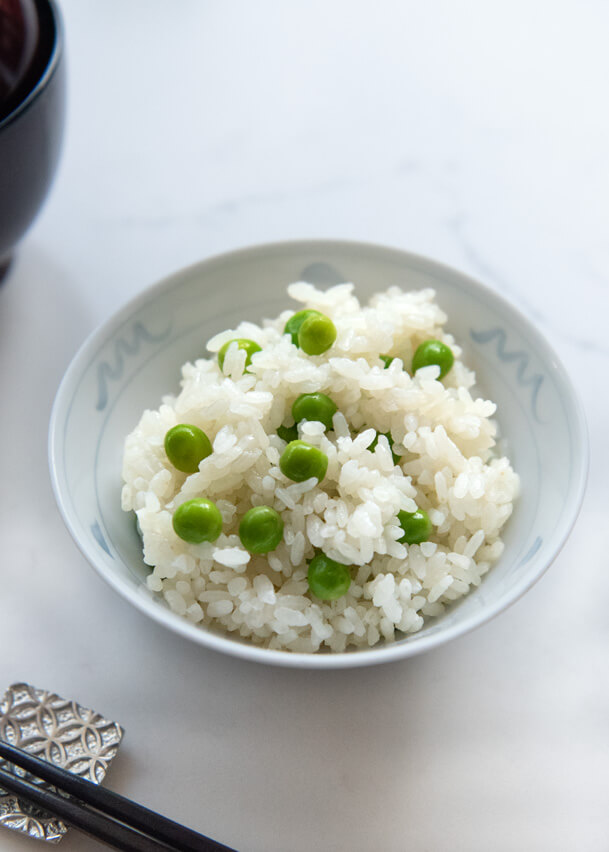
There are two different methods of making Japanese Green Pea Rice: the takikomi gohan method—cooking the rice with the green peas in it, and the maze gohan method—cooking the rice and peas separately, then mixing them together.
I used the maze gohan method for the good reasons described in the following section.
Mame Gohan – A Signature Flavour of Spring
Japanese Green Pea Rice is called ’mame gohan’ (豆ご飯). The word ‘mame’ (豆) is a general term for the seeds of leguminous plants, or the individual seeds contained in their pods such as edamame, azuki beans, chick peas etc. ‘Gohan’ (ご飯) means cooked rice.
Perhaps because Japanese Green Pea Rice is such a representative rice dish using beans, you don’t have to specify what type of mame it contains. Incidentally, rice dishes using other kinds of beans, such as edamame and azuki beans, are called ‘edamame gohan’ and ‘azuki gohan’, respectively.
The vibrant green colour in the freshly cooked rice brings a sense of spring and early summer to the table. It is a traditional Japanese dish that allows you to savour the changing seasons.
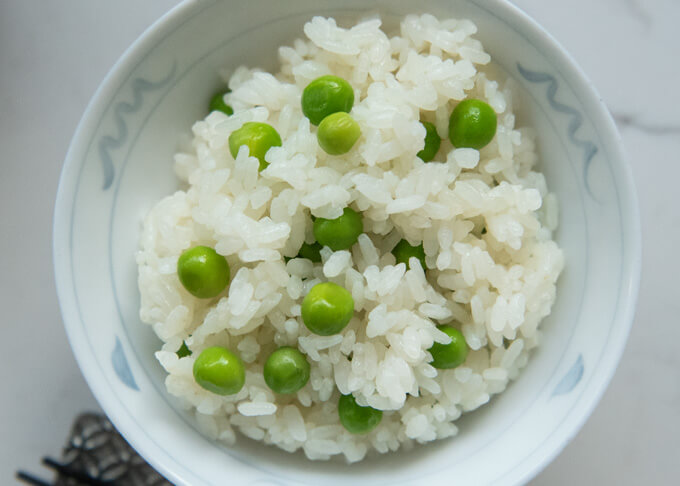
As mentioned in the post, Rice with Azuki Beans (Osekihan) is the rice dish most commonly served on special occasions. But in spring, mame gohan is also served in place of osehikan as a seasonal celebratory dish.
How to Keep Peas Bright Green and Plump
The hero of today’s dish is green peas. So, you want to cook your peas to their full potential, i.e. bright green and plump. Nothing is more unappetising than mame gohan with discoloured and wrinkly peas.
Discolouration occurs when chlorophyll (the green pigment) is broken down by heat. If you mix the fresh peas in the rice and cook them together, the peas will turn a moss green colour.
But if you cook the peas separately and mix the peas with the flavoured cooked rice, you can retain their bright green colour. After boiling peas, you need to cool them down to avoid discolouration.
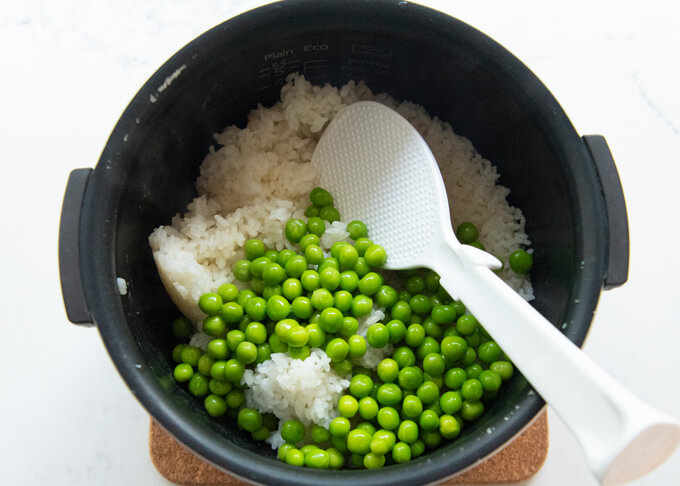
The surface of the peas becomes wrinkly if you drain them while they are still hot and let them cool naturally. This is because the water inside the green peas escapes as steam. Putting the boiled peas in ice water to cool them down quickly can also result in wrinkly peas because of the sudden temperature difference between the peas and their skins.
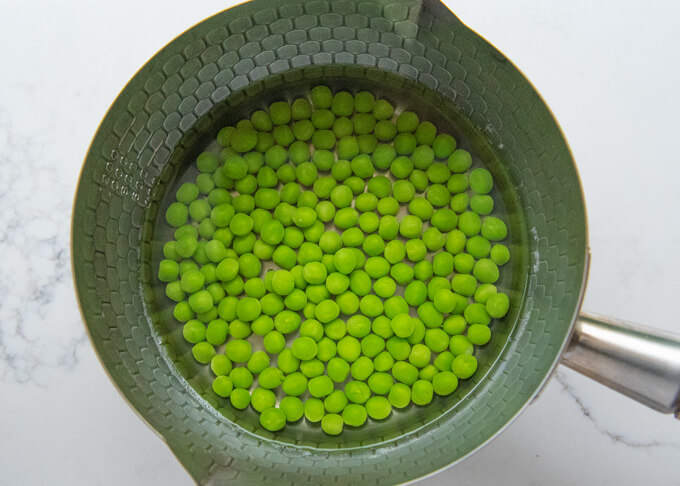
To prevent the peas from wrinkling, leave the boiled peas in the cooking water without draining them and let them cool gradually in the cooking water. You will be surprised to see how plump and vibrant green they are.
What’s in My Japanese Green Pea Rice (Mame Gohan)
There are surprisingly few ingredients.
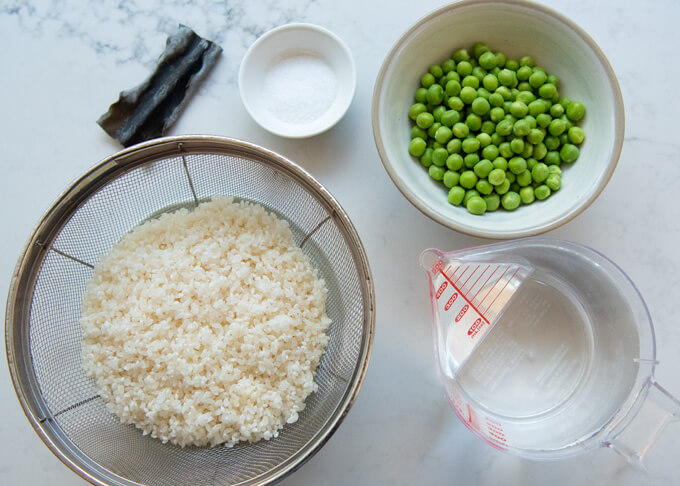
- Green peas
- Water
- A pinch of salt
- Short grain rice
- 1 tsp salt
- 5cm x 10cm / 2″ x 4″ konbu (kelp).
It is best to use fresh green peas in their pods. Green peas are seasonal and you probably won’t see them at vegetable shops in winter. If peas are out of season, you could use frozen peas instead of fresh peas.
How to Make Japanese Green Pea Rice (Mame Gohan)
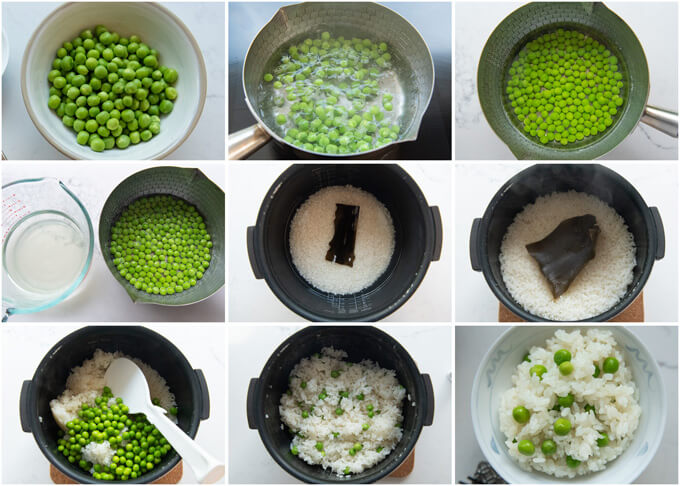
- Wash rice and soak in water for 30 minutes.
- Remove the peas from the pods, quickly rinse them, and boil in a pot of water with a pinch of salt.
- Turn the heat off and leave the peas in the cooking water. Let them cool.
- Transfer the cooking water to a measuring cup, leaving enough water in the pot to keep the peas submerged.
- Drain the rice and put it in the inner pot of a rice cooker.
- Add the reserved pea-cooking water, salt, a sheet of konbu to the pot, then cook the rice.
- Remove the konbu. Mix the peas into the cooked rice and serve.
I used a rice cooker, but you can also cook rice in a heavy-bottomed saucepan. I have included instructions for both methods in the recipe card.
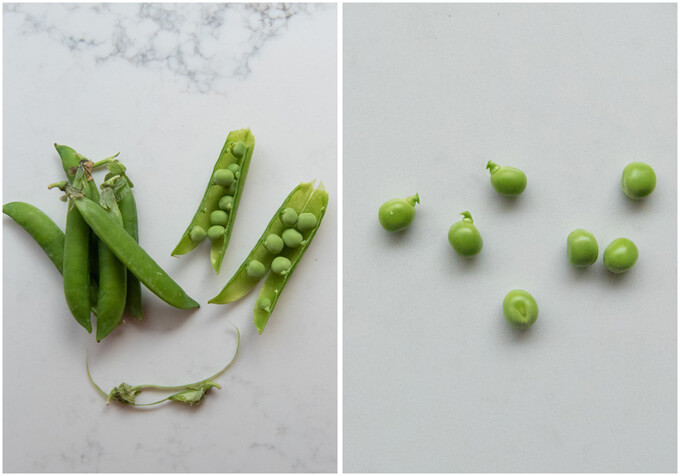
When you remove the peas from their pods, some of them may have a little funiculus attached (the small stalk that connects the seed to the pod). You need to remove it before cooking, as it will detach during cooking and mixing into rice.
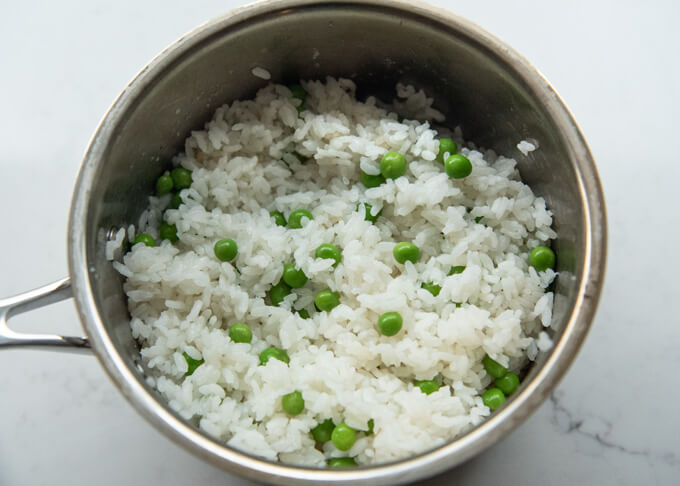
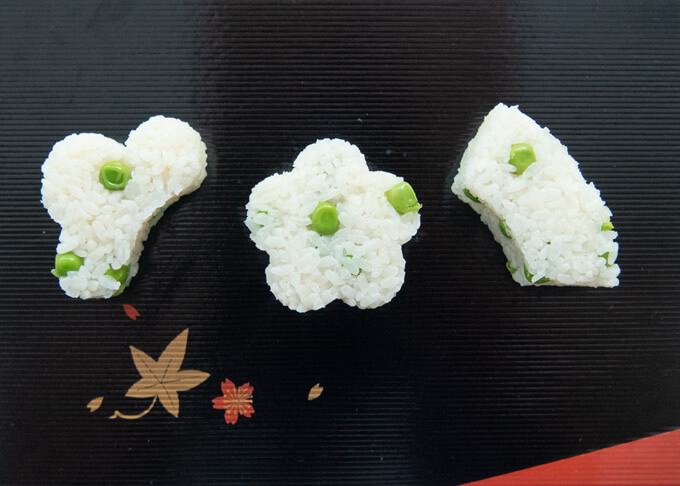
Japanese Green Pea Rice (Mame Gohan) is a visually attractive rice dish. It is not only served on special occasions but is also great for putting in a bento box. Mame gohan is sometimes served moulded to make it look special. See how pretty it looks when you mould the rice!
Yumiko
Japanese Green Pea Rice looks as if round jade gemstones are scattered throughout the rice. The charm of Japanese Green Pea Rice comes from the rich aroma of fresh, seasonal peas and their natural sweetness, which is enhanced with a simple seasoning of just salt.
Cook Time does not include the time to boil peas because you can do it while soaking the rice. The same applies to Prep Time for taking peas out of their pods.
- 100g / 3.5oz green peas (about 250g / 8.8oz in their pods, note 1)
- 500ml / 1.1pt water
- 360ml / 0.8pt short grain rice (2 Japanese rice cups)
- 1 tsp salt
- 10cm / 4" x 5cm / 2" konbu (kelp)
-
Wash rice and soak in water for 30 minutes.
-
Take the peas out of their pods and remove the little funiculus (the tiny stem attached to the pea), if they are still attached. Quickly rinse the peas.
-
Bring the 500ml / 1.1pt water to a boil in a pot, add a pinch of salt (not in the ingredients list) and the peas, and cook for 4-5 minutes.
-
Turn the heat off and let the peas cool in the cooking liquid. If the room temperature is high, you can place the pot in water to speed up the cooling process.
-
Pour most of the cooking liquid from the pot into a measuring cup, leaving the peas and enough liquid in the pot to keep the peas submerged.
-
Drain the rice and put it in a heavy-bottomed saucepan or the inner pot of a rice cooker.
-
If using a saucepan: Add 405-425ml / 0.85-0.9pt (note 2) of the reserved cooking liquid (plus water if there is not enough) and salt to the pan. Mix and place the konbu in the centre. Cook the rice following the steps 4 – 6 of How to Cook Rice the Japanese Way.
-
If using a rice cooker: Add the reserved liquid (plus water if there is not enough) to the line marked for 2 rice cups and salt to the pan. Mix and place thekonbu in the centre. Cook as you would normally cook short grain rice (note 3).
-
When the rice is cooked, remove the konbu (note 4).
-
Drain the peas and add them to the rice. Gently mix the peas into the rice using a spatula, ensuring that evenly distributed.
1. I strongly recommend buying green peas in pods in season. But if peas are out of season, you can use frozen peas. The only adjustment you need to make if using frozen peas is the duration of boiling the peas. You should boil only for a couple of minutes.
2. The amount of water required depends on your preference for the cooked rice (al dente vs soft), age of the rice grain (new rice needs less water), and the pot you use (more steam evaporates with a wider pot). You will need to experiment and work out the exact amount that suits you.
3. If your rice cooker comes with a cooking option that includes soaking time (therefore it takes more than 1 hour to cook) like mine, you should use the 'Quick' cooking option to skip the water absorption time.
Alternatively, you can prepare the peas first, then add the pea-cooking water to the washed rice and use the regular setting to cook, including soaking time.
4. You can eat cooked konbu. It's good for you.
5. Mame gohan can be left for a couple of days in the fridge and up to 1 month in the freezer. But the quality of the peas, both colour and plumpness, will degrade slightly.
Meal Ideas
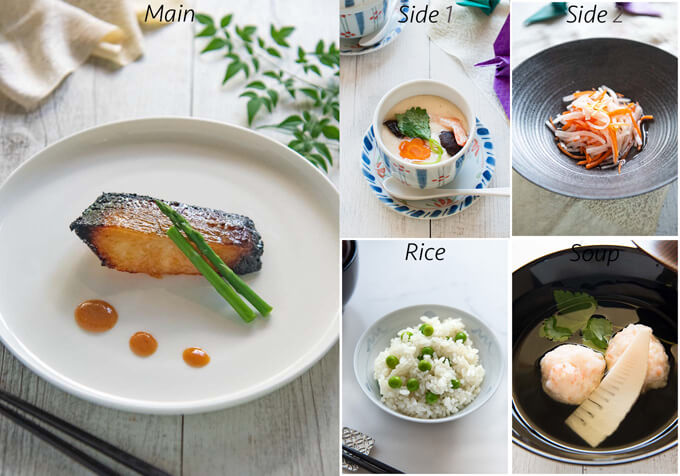
A typical Japanese meal consists of a main dish, a couple of side dishes, a soup and rice. I try to come up with a combination of dishes with a variety of flavours, colours, textures and make-ahead dishes.
Mame gohan celebrates spring and I thought of listing some dishes that represent spring. But I already posted a couple of spring Meal Ideas in the posts Takenoko No Tosani and Wakatake-ni. So today, I came up with the dishes that can be served on special occasions.
The main should be a fish dish. Nobu’s miso marinated black cod can certainly measure up to a special occasion. Sashimi is also a great option.
I can’t think of a better side dish for a special day than chawanmushi. Just having it alongside other dishes makes the meal feel special. Clear soup is also commonly served on special occasions.
- Main: Nobu’s Miso Marinated Black Cod Recipe – marinate ahead of time.
- Side dish 1: Chawanmushi (Savoury Egg Custard) – or other style of chawanmushi such as Fish Chawanmushi (Savoury Egg Custard) and Plain Chawanmushi with Starchy Clear Sauce.
- Side dish 2: Pickled Carrot and Daikon Recipe (Kōhaku Namasu) – or Sweet and Sour Pickled Red Cabbage.
- Soup: Shrimp Balls (Ebi-shinjo) in Clear Soup – or Clear Soup with Clam, Japanese Clear Soup with Whiting (Kisu no Osuimono).
- Rice: Japanese Green Pea Rice (Mame Gohan) – today’s recipe. You can make ahead.
I love green peas!
Thank you for sharing the recipe! Excites to try this tomorrow.
Such a lovely way with rice!💕
Hi Anne, please let me know what you think!
A very easy recipe one could so easily make incorrectly – thank you for the tip which will be promptly used 🙂 !
Hi Eha, thank myou. Please let me know what you think when you made it!