I am excited to show you how to make a copycat version of the Japanese 7-Eleven Egg Sandwich. The filling is simply egg mixed with Kewpie mayonnaise and seasonings, but the combination of soft Japanese bread and the creamy filling is unforgettable.
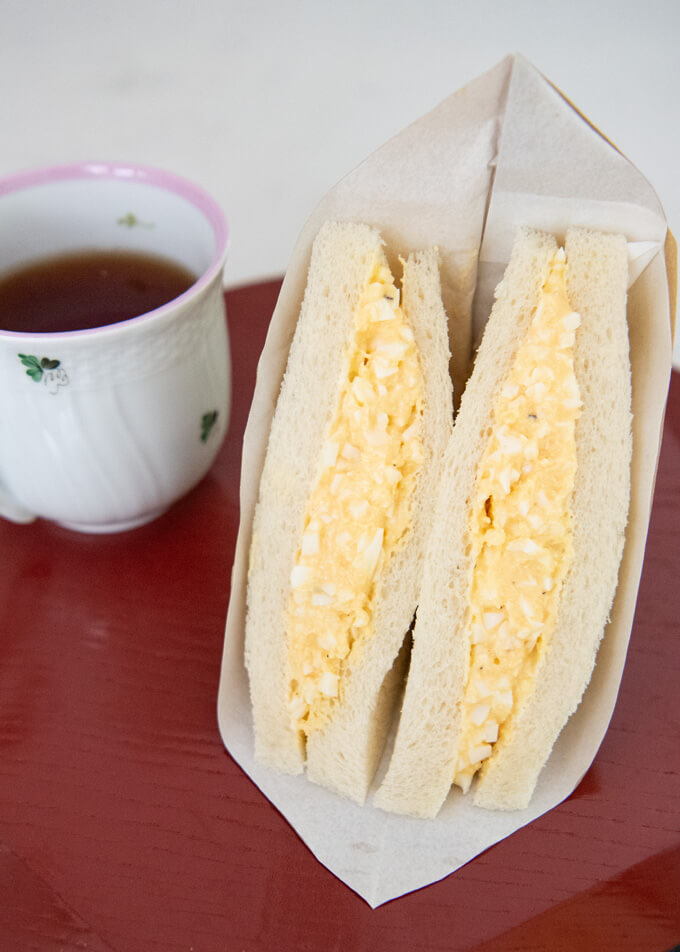
Nagi told me that the 7-Eleven Egg Sandwich is all the rage at the moment, and people go crazy for the Japanese version. I had no idea, but apparently the 7-Eleven Egg Sandwich went viral among Americans quite some time ago.
It is said that David Chang introduced the Lawson (another Japanese convenience store) egg sandwich to Anthony Bourdain. Bourdain wrote about it in his book No Reservations.
So here is my interpretation of the Japanese 7-Eleven Egg Sandwich.
In pursuit of the 7-Eleven Egg Sandwich
I hadn’t tasted the 7-Eleven Egg Sandwich in Japan until recently. Why would I eat Western food while I was in Japan when there are so many amazing Japanese dishes to try?
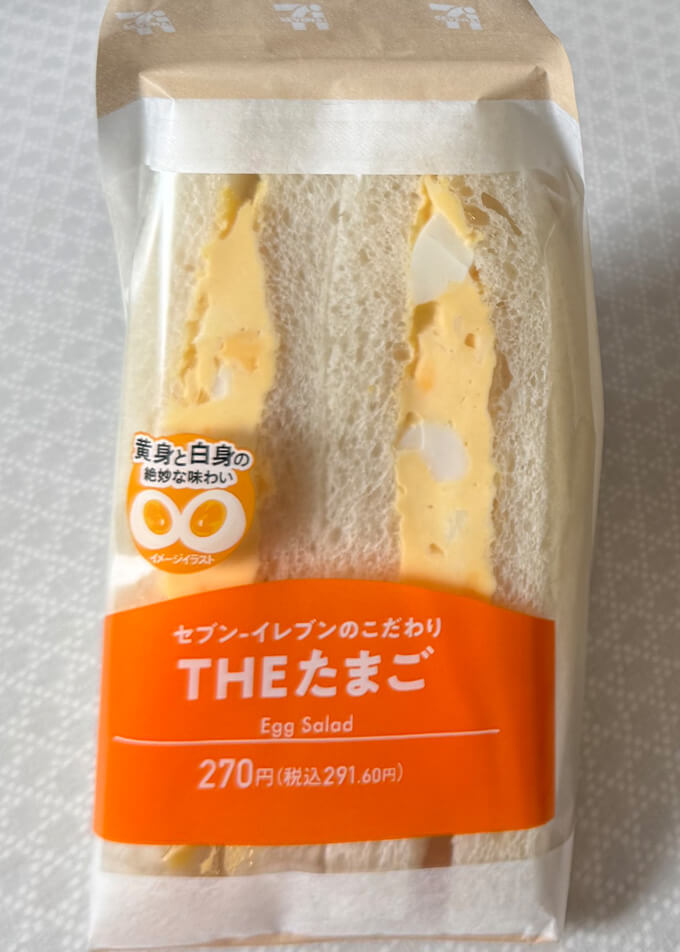
7-eleven Tamago Sando that I bought in Tokyo.
I offered my version of the egg sandwich to the RecipeTin Meals (RTM) team to taste test more than a month ago. One of them, who had eaten the 7-Eleven version in Japan, told me that the real one contained more mayonnaise. That got me thinking I should fly to Japan just to taste an authentic 7-Eleven Egg Sandwich.
Just kidding.
But I recently visited my relatives in Japan and finally tried the Japanese 7-Eleven Egg Sandwich for the first time. I had to agree that the filling is slightly creamier and richer, almost oily. But I still thought my version was pretty good.
I also bought egg sandwiches from other popular convenience stores, including Lawson and FamilyMart. I wanted to compare them and see whether the 7-Eleven egg sandwich really stood out.
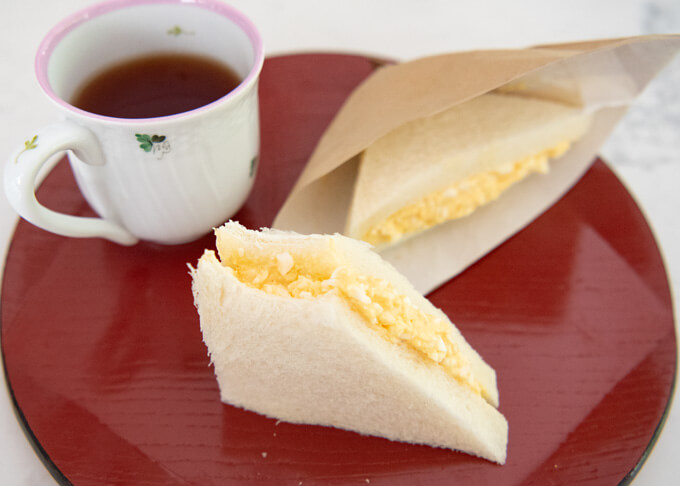
I’ve included my taste-testing report in the subsequent section below.
About the Japanese 7-Eleven Egg Sandwich
In Japan, an egg sandwich is called ‘tamago sando’ (たまごサンド). The word ‘tamago’ (たまご) means egg, and ‘sando’ (サンド) is the shortened form of ‘sandwich’. Incidentally, Japanese people pronounce the full word ‘sandoicchi’ (サンドイッチ).
I was curious why the filling of the 7-Eleven Tamago Sando was so popular and seemed different from the egg sandwiches sold in Australia. There are a few secrets to making an egg sandwich that closely resembles the 7-Eleven version.
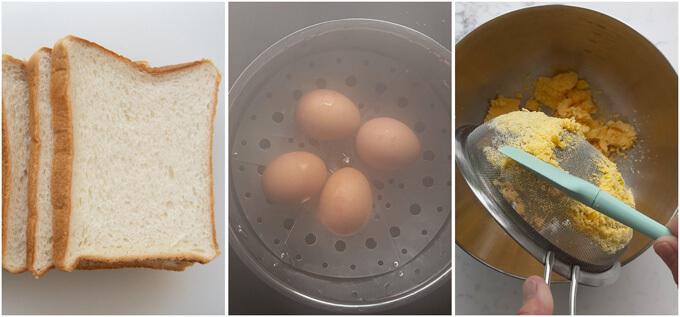
- Use Japanese milk bread (left photo above): It is called ‘shokupan’ (食パン) in Japanese. It is light, fluffy, soft, and slightly sweet. You can read more about Japanese milk bread in Café-style Japanese Sandwiches.
- Steam the eggs instead of boil them (middle photo above): There are subtle differences in the textures between boiled and steamed eggs. Because the eggs are heated more gently in a steamer, they turn out softer and more tender. In addition, adding the eggs to a steamer does not cause a sudden drop in cooking temperature, which makes them easier to peel. Unlike boiling, steaming also reduces the risk of cracked shells because the eggs don’t knock against each other during cooking.
- Put the egg yolk through a sieve (right photo above): The egg filling in the 7-Eleven Tamago Sando is very creamy and smooth. Sieving the yolks before mixing them with the mayonnaise helps create a silky, paste-like consistency.
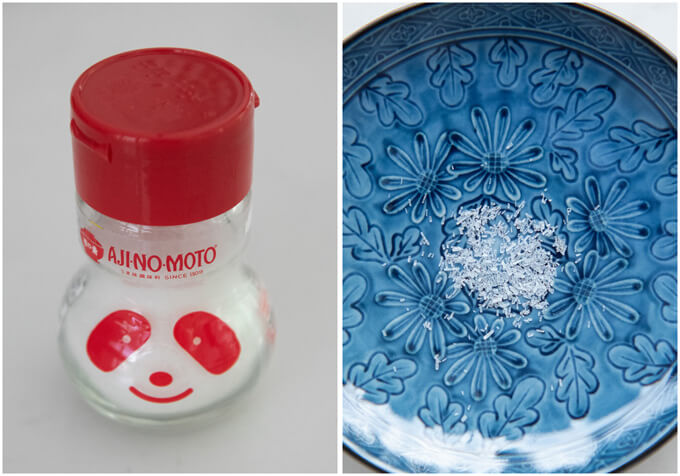
- Add MSG (optional): The 7-Eleven egg filling is packed with umami. Although Kewpie mayonnaise already contains umami, I felt that the 7-Eleven version, which uses its own mayonnaise, had an even stronger savoury flavour. Adding a small amount of Aji-no-moto (MSG) enhances the taste even further.
Comparing 3 Convenience Store Egg Sandwiches
The top 3 convenience store chains in Japan are 7-Eleven, FamilyMart, and Lawson (in order of market share). Although each has its own brand products, they sell many similar foods and everyday goods. Egg sandwiches are no exception.
I bought a Tamago Sando from each store and compared both the appearance and the taste. Then I did a blind taste test with my son.
Packaging and Price
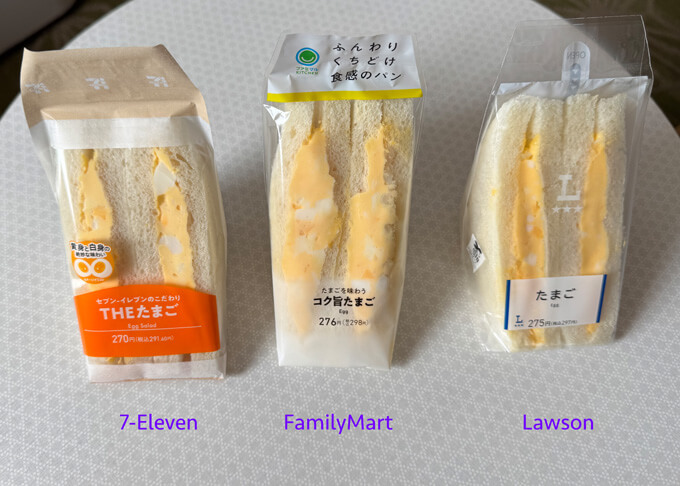
All these sandwiches are tightly packaged in triangular plastic wrappers. Of the three, the Family Mart sandwich looked a little untidy because the egg filling was overflowing.
Price-wise, 7-Eleven was the cheapest, although the difference between the lowest and the highest price was only ¥6.
Egg Filling
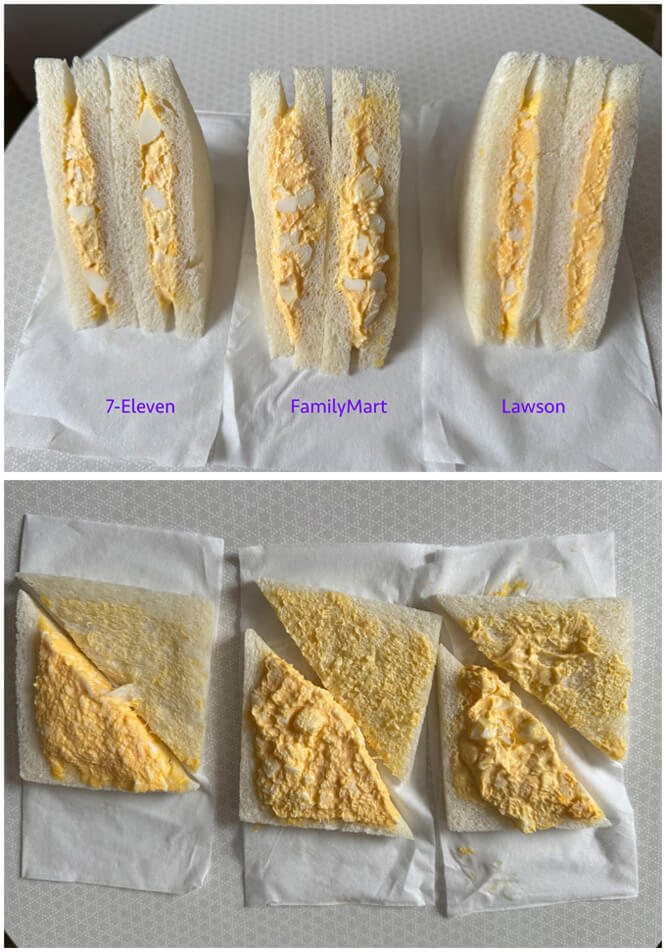
FamilyMart had the most generous amount of filling, followed by 7-Eleven, and then Lawson. This explains why the FamilyMart packaging looked messy.
Not obvious in the photo above, but the colour of the 7-Eleven filling was slightly paler than others and it had a strong mayonnaise flavour.
The pieces of egg white in the 7-Eleven sandwich were finer and less chunky than those in the other brands.
Blind Taste Test
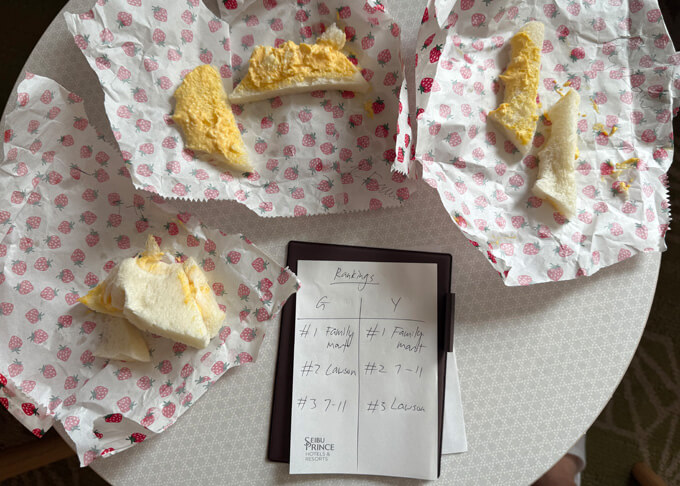
Both my son and I liked the FamilyMart Tamago Sando the best. We particularly enjoyed its chunky pieces of egg white, which added texture, and the moderate creaminess of the filling.
I ranked 7-Eleven 2nd and Lawson 3rd, while my son put Lawson in 2nd place and 7-Eleven in 3rd. Although we ranked 3 sandwiches differently, the differences were marginal and all of them were delicious. Ultimately, it comes down to personal preference.
Interestingly, I felt that my version of the 7-Eleven Egg Sandwich was actually closer to the FamilyMart version than to the 7-Eleven original.
What’s in My 7-Eleven Japanese Egg Sandwich
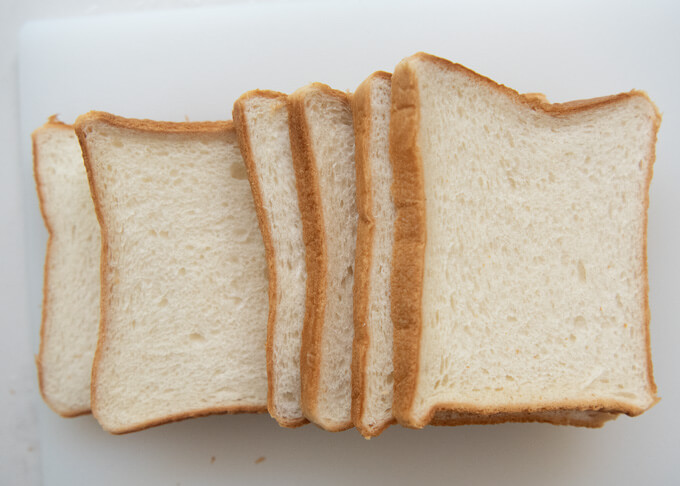
- Shokupan (Japanese milk bread) sliced 1.5cm thick
- Softened butter (forgot to include in the photo above).
If a Japanese bakery is nearby, you can buy a fresh loaf of shokupan. Otherwise, frozen sliced shokupan is often available at Japanese/Asian grocery stores.
I bought a bag of 4-slice PASCO Choujuku Shokupan (3cm / 1⅛” thick slices) and halved each slice to make 1.5cm / ⅝” thick slices. If you can find an 8-slice loaf , you won’t need to halve the slices.
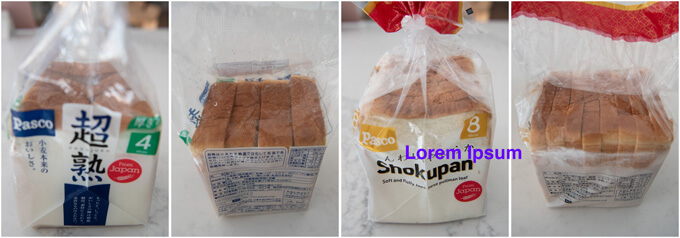
Left: 4-slice pack shokupan. Right: 8-slice pack shokupan.
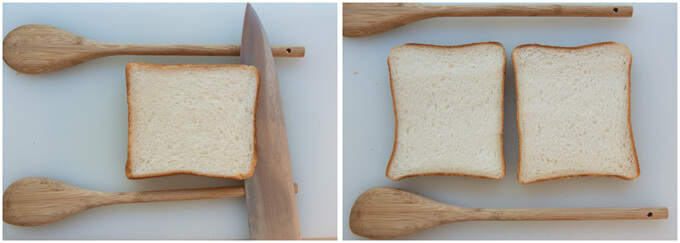
To halve a 3cm / 1⅛” thick slice, place 2 sticks, whose thickness is 1.5cm / ⅝”, on both sides of a slice of bread. Place a sharp long knife (not a serrated knife) flat, with the blade touching the both sticks. Slide the knife to cit the bread horizontally, making sure the blade is always touching the sticks.
Egg Filling
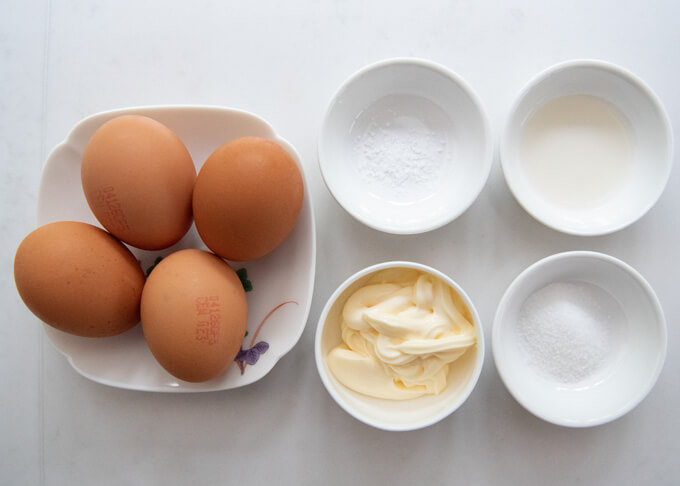
- 4 steamed or boiled eggs
- Kewpie mayonnaise
- Salt
- Sugar
- Rice wine vinegar
- Aji-no-moto (MSG, optional).
I prefer steamed eggs, but boiled eggs work well too. There are subtle differences between steamed and boiled eggs as explained in the earlier section.
Aji-no-moto is optional, but it will certainly make a difference in the flavour of the egg filling.
How to Make a 7-Eleven Japanese Egg Sandwich
At a high level, the process of making this egg sandwich is no different from my other sandwiches such as Café-style Japanese Sandwiches: make the filling, butter the bread, sandwich the filling between two slices, and cut. But making this filling involves an extra step to make it extra creamy.
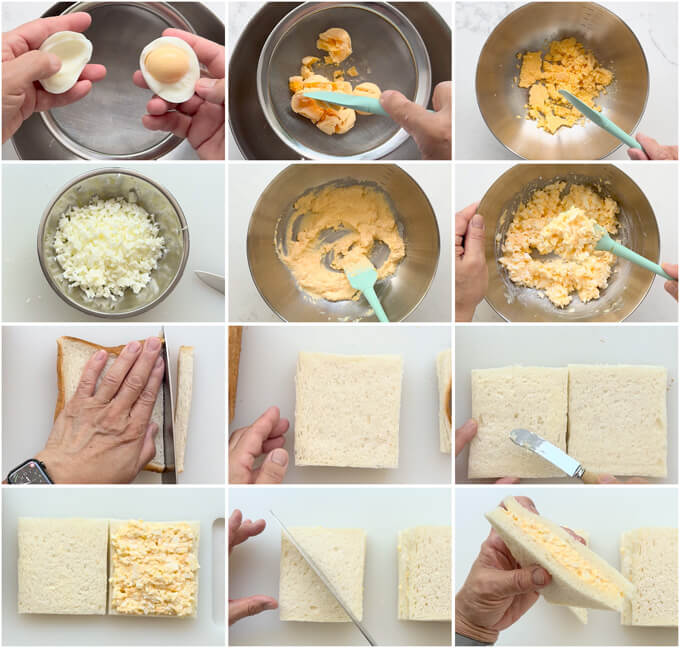
- Separate the egg yolks from the egg whites. Press the egg yolk through a sieve into a bowl to create a fine powdery texture. Finely dice the egg whites and set them aside.
- Add the remaining Egg Filling ingredients to the bowl with the egg yolks and mix well.
- Add the diced egg whites to the bowl and mix until well combined.
- Remove the crusts from the bread and lightly butter the inside of each slice.
- Spread the egg filling over one slice of each sandwich, then place the other slice on top.
- Gently cut each sandwich diagonally. Serve them on a plate, with the cut side facing up.
You can make the egg filling ahead of time and keep it in the fridge 2-3 days. However, once you have assembled the sandwiches, you should consume it within a day.
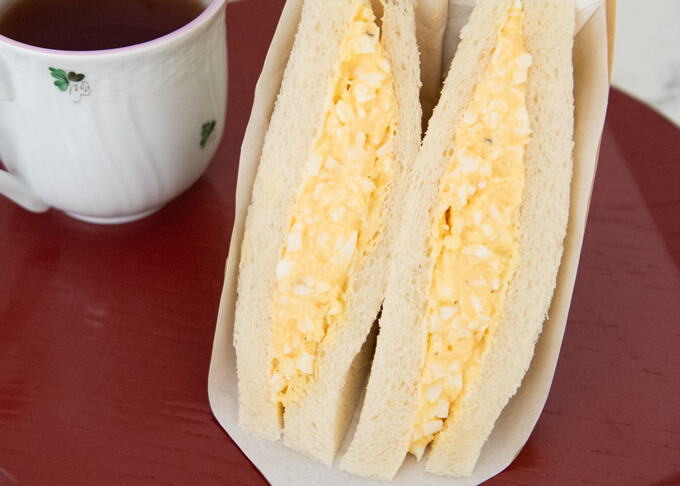
In my pursuit of perfecting this Japanese 7-Eleven Egg Sandwich recipe, I ended up eating quite a few sandwiches while I was in Japan. I also ate countless egg sandwiches at home while experimenting with the filling. Yet, I never got sick of them – they are just that good!
Yumiko
Watch How To Make It
This recipe shows you how to make a copycat version of the Japanese 7-Eleven Egg Sandwich (Tamago Sando). The filling is simply egg with mayonnaise and seasonings, but the texture of the Japanese bread and the creamy filling is unforgettable, let alone the umami induced flavour.
Eggs can be boiled or steamed. I included the steaming method in the instructions, which is reflected in the cooking time.
Don't forget to see the section 'MEAL IDEAS' below the recipe card! It gives you a list of dishes that I have already posted and this recipe that can make up a complete meal. I hope it is of help to you.
- 6 slices Japanese shokupan (milk bread, 1.5cm / ⅝" thick, note 1)
- Softened butter
- 4 eggs (uncooked, straight from the fridge)
- 3 tbsp Kewpie mayonnaise (note 2) (45g / 1.6oz)
- 2 pinches salt
- ½ - 1 tsp sugar
- 1 tsp rice wine vinegar
- 1/8 tsp Aji-no-moto umami seasoning (optional, note 3)
-
Add about 2 cups of water in the steamer and bring it to a boil.
-
Place 4 eggs direct from the fridge into the steamer. Make sure the egg does not touch the side of the steamer. Where the egg shell touches the side of the steamer, the egg white will have a burnt patch. You can place scrunched baking paper in to secure the position of the eggs if needed.
-
Cover with a lid and steam for 12-13 minutes.
-
Transfer the eggs to a bowl filled with ice water and cool them down quickly.
-
Make a shallow incision around the egg white and gently open it so that you can remove the egg yolk without breaking it. Separate the yolk from the white.
-
Push the egg yolk through a fine sieve and collect the powder-like yolk in a bowl.
-
Finely chop the egg white into about 5mm / 3⁄16" cubes (or similar-sized pieces).
-
Add the remaining Egg Filling ingredients to the bowl with yolk and mix well with a spatula until the mixture becomes paste-like.
-
Add the diced egg white to the bowl and mix well.
-
Stack two slices of shokupan together and trim off the crusts. Repeat with the remaining slices.
-
Thinly spread butter on the inside surface of each slice.
-
Working with one pair at a time, place the slices on a cutting board, buttered side up, and spread 1/3 of the egg filling onto one slice.
-
Spread the filling all the way to the edges, keeping the filling in the middle slightly thicker, then place the other slice on top, butter side down.
-
Gently but firmly press the sandwich with your palm.
-
Repeat with the remaining 2 pairs.
-
Working with one sandwich at a time, cut the sandwich diagonally using a sharp knife (not a serrated knife). Move the blade of the knife sideways back and forth initially to cut the bread until the blade reaches to the filling, then push the blade down to cut through the rest (note 5).
-
Repeat for the other pairs.
-
Transfer the triangular egg sandwiches to a serving plate, with the cut side facing up.
1. Shokupan is Japanese milk bread. If a Japanese bakery is nearby, you can buy a fresh loaf. Otherwise, frozen sliced shokupan is often available at Japanese/Asian grocery stores.
I bought a bag of PASCO Choujuku Shokupan (4 slices) and halved each slice to make 1.5cm-thick slices (see the photo in the post). If you can find an 8-slice loaf (see the photo in the post), you won’t need to halve the slices.
You can use standard sandwich bread, but I strongly recommend that you use shokupan because the soft texture and the slightly sweet flavour of the bread is a significant component of the Japanese 7-Eleven Egg Sandwich.
2. Kewpie mayonnaise has a quite different flavour from Western-style mayonnaise. It is less acidic and contains umami. I strongly recommend using Kewpie mayonnaise today so that your egg sandwich tastes as close as possible to the Japanese 7-Eleven Egg Sandwich. If you use Western-style mayonnaise, it will completely change the flavour of the egg sandwich.
3. Aji-no-moto umami seasoning is MSG made by Ajinomoto Corporation. In 1960s, MSG had a negative reputation due to health concerns that were not supported by scientific evidence. It is now widely recognised as safe to consume. I list it as optional because you may not have it in your pantry. But if you use it, I can guarantee that it will noticeably enhance the flavour of the egg filling.
4. In this recipe, eggs are steamed instead of boiled as I wanted to make the recipe as close to the original as possible. This is because Japanese 7-Eleven Egg Sandwich uses steamed eggs. I have never steamed eggs like this before, but I now prefer them for the reasons I explained in the post. If you prefer, you can use hard boiled eggs instead.
5. If you continue sliding the knife sideways after it reaches the filling, the cut side will become messy because the egg filling will be dragged through the bread.
Meal Ideas
A typical Japanese meal consists of a main dish, a couple of side dishes, a soup and rice. I try to come up with a combination of dishes with a variety of flavours, colours, textures and make-ahead dishes.
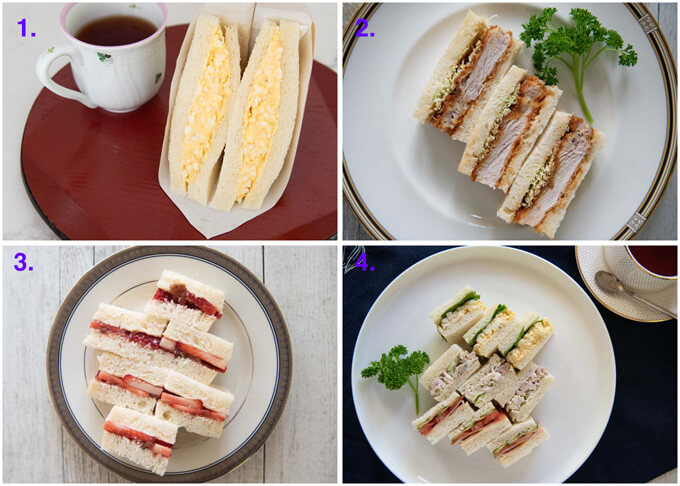
Before today’s recipe, I had already shared three different sandwich recipes, so I thought I’d list them all here as a recap.
- Japanese 7-Eleven Egg Sandwich (Tamago Sando) – today’s recipe.
- Katsu Sando (Pork Cutlet Sandwich) – sandwich with pork cutlet smeared with fruity Japanese sauce.
- Ichigo Sando (Strawberry and Cream Sandwich) – fruit sandwich, which is popular among Japanese people.
- Cafe-style Japanese Sandwiches – typical sandwiches served at cafes in Japan.
We love our egg salad sandwiches, as we call them here in the southern U.S. If it’s not made with Duke’s mayo, it ain’t egg salad sandwich. But the Japanese version really takes things up a notch. I love the little kick of umami. We subbed a tiny bit of soy sauce for the MSG, per a suggestion from Google, and made shokupan in the breadmaker. The bread was just OK; I think I’ll have to find somewhere to order it next time. But 10 of the 10 for the filling!
Hi Lisa, thank you for giving it the highest score! Using soy sauce is genius!