Of the four variations of gyoza that I mentioned in my post Steamed Gyoza, Boiled Gyoza Recipe (Sui Gyoza) is probably the easiest to cook. Boiling the gyoza dumpling makes the wrappers softer and the filling juicier. The slightly garlicky soy-vinegar sauce adds another layer of flavour to the dish.
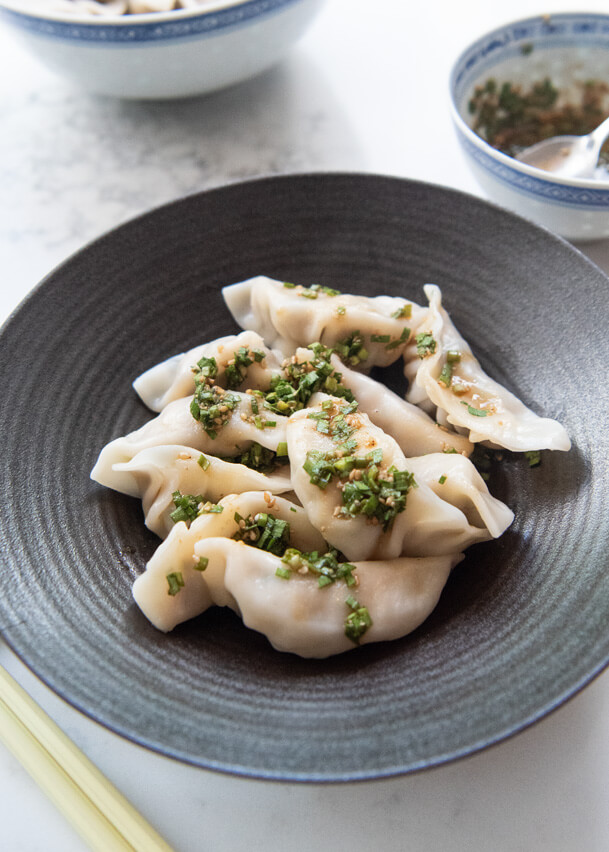
Boiled Gyoza is called ‘sui gyoza’ (水餃子) in Japanese. Like other gyoza dumplings, these originated in China. While pan-fried gyoza are the most popular type of dumpling in Japan, boiled dumplings (shui jiao) are commonly enjoyed as an everyday staple in China.
A classic gyoza filling is made with pork mince, cabbage, garlic chives, and seasonings, but I used a mixture of pork mince, prawns, and choy sum. The addition of prawns gives the filling a delicate flavour that suits boiled gyoza, which have a softer and more delicate texture than pan-fried gyoza.
What’s in my Boiled Gyoza Recipe (Sui Gyoza)
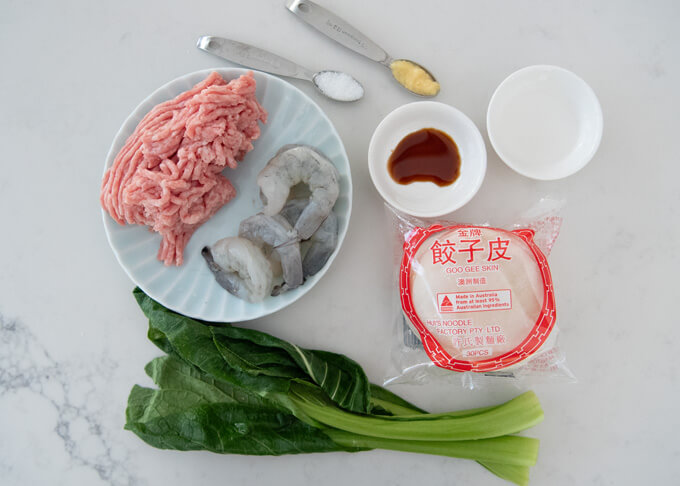
- 1 pack of gyoza dumpling skin (about 30 sheets)
- Pork mince
- Uncooked peeled prawns, diced into small pieces
- Finely chopped choy sum.
You don’t have to use prawns. If you omit them, simply increase the amount of pork mince to make up for them. Instead of choy sum, you can use green onions, other Asian greens, or spinach.
Flavouring
- Grated ginger
- Soy sauce
- Cooking sake
- Salt.
Garlic Chives Soy-vinegar Sauce
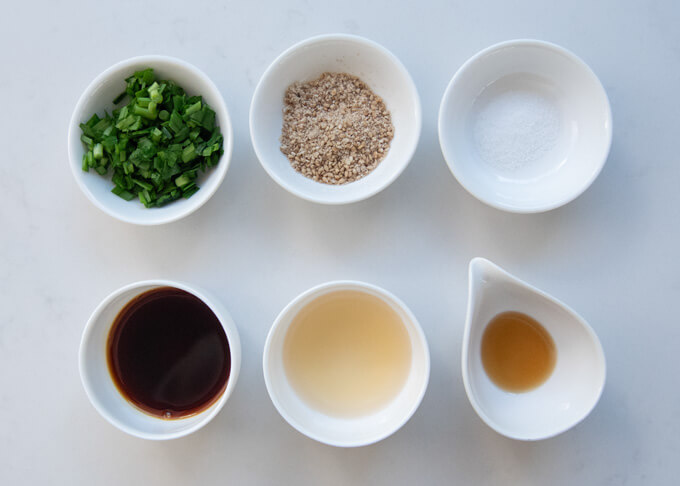
- Finely chopped garlic chives
- Grated roasted sesame seeds
- Soy sauce
- Rice wine vinegar
- Sesame oil
- Sugar.
“Gyoza must have garlic chives” – that’s my theory, which is why I made the sauce with garlic chives. But if you prefer, you can substitute them with finely chopped green onions.
How to make Boiled Gyoza Recipe (Sui Gyoza)
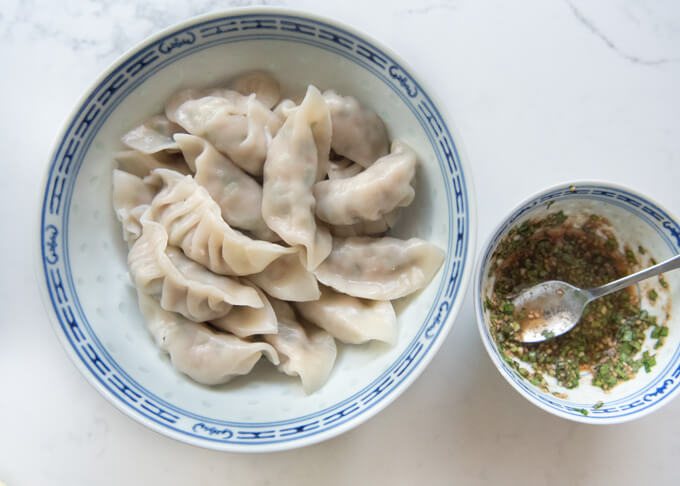
The process of making dumplings is identical to my pan-fried gyoza recipe, except that the filling is different. You can wrap the filling in the same way as for pan-fried gyoza, but today I made pleats in a slightly different way – pleating from the centre in both directions instead of just one direction.
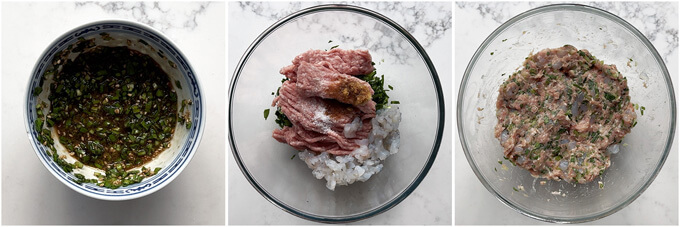
- Mix all the Sauce ingredients in a small bowl until the sugar dissolves.
- Put the pork mince, prawns, choy sum, and the Flavouring ingredients in a bowl. Mix well until the mixture becomes sticky.
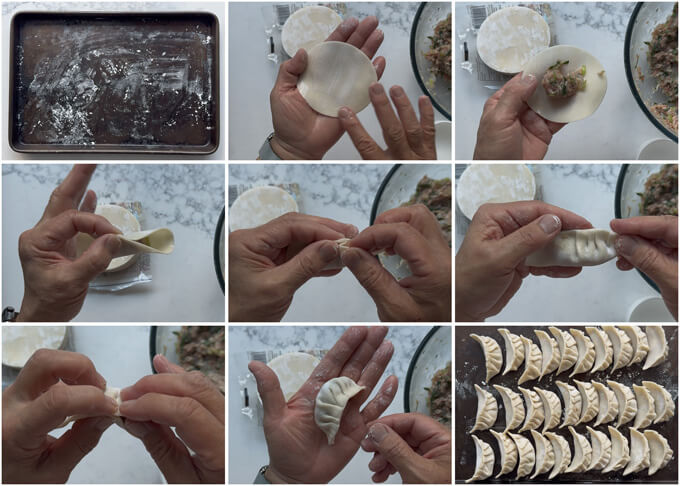
- Place one gyoza wrapper on your palm. Dip your finger in water and run it around half of the wrapper’s edge to help seal it.
- Place a lightly filled tablespoon of the filling in the centre of the wrapper.
- Fold the wrapper in half and pinch it together in the middle of the arc.
- Starting from the centre of the arc, make 4 pleats on one side, working outwards. Do the same on the other side of the arc. Repeat with remaining wrappers.
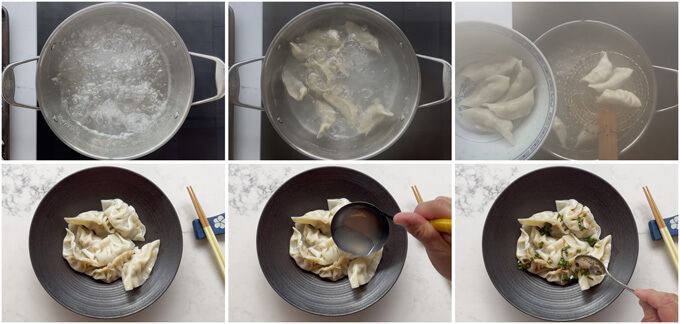
- Boil dumplings, then transfer the cooked gyoza to a serving bowl.
- Sprinkle a small amount of the cooking water from the pot over them.
- Drizzle the Garlic Chives Soy-vinegar Sauce over the dumplings and serve while hot.
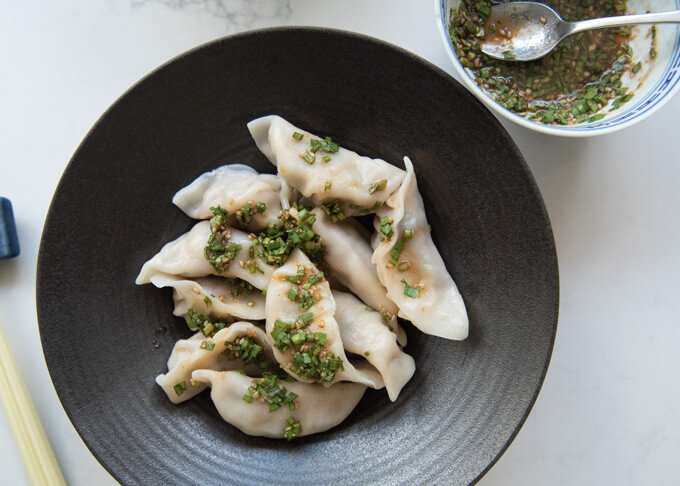
Sui Gyoza is best served straight from the boiling water. But if you are boiling the dumplings in batches as I did, you may want to return all the cooked gyoza back to the boiling water briefly to reheat them before serving.
Sui Gyoza freezes well, but not after cooking them. You can cook the frozen dumplings directly in boiling water without thawing them first. It will take about 6 minutes to cook them through. They are also great to serve in a soup.
Yumiko
Watch How To Make It
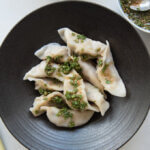
Boiled Gyoza Recipe (Sui Gyoza) is probably the easiest to cook among different variations of gyoza. Boiling the gyoza dumpling makes the wrappers softer and the filling juicier. The slightly garlicky soy-vinegar sauce adds another layer of flavour to the dish.
The cook time assumes the gyoza dumplings are cooked in 3 batches.
Don't forget to see the section 'MEAL IDEAS' below the recipe card! It gives you a list of dishes that I have already posted and this recipe that can make up a complete meal. I hope it is of help to you.
- 250g pork mince
- 100g uncooked prawns , chopped into about 5mm / 3⁄16" cubes about ⅖ cup)
- ⅔ cup choy sum , finely chopped (about 50g / 1.8oz, note 1)
- 30 gyoza wrappers (note 2)
- Corn flour/corn starch (to dust baking tray)
- ½ tsp grated ginger
- ½ tsp salt
- ½ tsp soy sauce
- ½ tbsp cooking sake
- 2 tbsp garlic chives , finely chopped
- 2 tsp grated roasted white sesame seeds
- 1 tbsp soy sauce
- ½ tbsp vinegar
- ½ tsp sesame oil
- ¼ tsp sugar
-
Mix all the Garlic Chives Soy-vinegar Sauce ingredients in a small bowl until the sugar dissolves.
-
Place the pork mince, prawns, choy sum, and the Flavouring ingredients in a bowl. Mix well until the mixture becomes sticky.
-
Sprinkle a baking tray with a generous pinch of corn flour/cornstarch.
-
Place one gyoza wrapper on your left palm (for right-handed people), with the side that has less starch on it facing up. Dip your right finger in water and run it around the edge of half of the wrapper to help seal it.
-
Place a lightly filled tablespoon of the filling (note 4) in the centre of the wrapper.
-
Fold the wrapper over from the edge closest to you and pinch the middle of the arc with your left fingers so that the arc faces upwards.
-
Starting from the centre of the arc, use the right thumb and index finger (for right-handed people), assisted by the left thumb, to fold the edge towards the centre. Make 4 pleats on the right half of the arc.
-
Repeat on the left half of the arc, folding the pleats towards the centre so that both sides are pleated towards the middle instead of in one direction (note 5).
-
Repeat with the remaining wrappers.
-
Fill a large pot with water to a depth of at least 4cm / 1 9⁄16" . Bring it to a boil
-
Put 10 gyoza pieces into the pot (note 6) and cook for 4 minutes. Transfer the cooked gyoza to a bowl or plate. Repeat with the remaining dumplings.
-
Transfer the cooked dumplings to a serving plate, then drizzle a small amount of the hot cooking water over them to prevent the gyoza from sticking to one another.
-
Drizzle the Garlic Chives Soy-vinegar Sauce over the gyoza and serve while hot (note 7).
1. Separate the stems from the leaves of the choy sum. If the stems are thick, halve them lengthwise, then chop them into small pieces. Cut the leaves into thin strips lengthwise, then chop them into small pieces.
Other vegetables such as green onions, other Asian greens, and spinach make a good substitute.
2. My pack of gyoza wrappers contained 30 sheets. Depending on the brand, a pack may contain slightly more or fewer wrappers. If the number of wrappers is close to 30, you don't need to adjust the total quantity of the filling.
3. If you are not fond of garlic chives or cannot find them, substitute them with finely chopped green onions.
4. Dividing the filling evenly among the wrappers can be challenging unless you have a kitchen scale.
If you have a scale, weigh the entire filling and divide the weight by the number of wrappers to work out the weight of filling per wrapper. Leave the bowl with the filling on the scale and reset the scale to zero. For each wrapper, remove filling with a spoon until the displayed weight reaches to the calculated amount.
Alternatively, use a tablespoon and see how full it should be based on the calculated weight.
If you don’t have a scale, simply use a lightly filled tablespoon per the instruction. However, when you have about 8 wrappers remaining, divide the remaining filling equally among the remaining wrappers so that you can use up all the filling.
5. For the left side of the arc, I turned the dumpling around so that the folding side was facing away from me. This allowed me to use my right fingers to make the pleats (as shown in the video). I simply can’t fold pleats with the left hand quickly enough 😂. If you are more dexterous than I am, there is no need to turn the dumpling around.
6. I used a 24cm / 9.5" pot. If your pot has a larger or smaller surface area, you can cook more or fewer gyoza at one time.
7. Sui Gyoza is best served straight from the boiling water. But if you are boiling the dumplings in batches as I did, you may want to return all the cooked dumplings to the boiling eater briefly to reheat them before serving.
8. Sui Gyoza freezes well before cooking, but not after. You can cook the frozen dumplings directly in boiling water without thawing them first. It will take about 6 minutes to cook through. They are also delicious served in soup.
9. Nutrition per piece.
serving24g calories56kcal fat1.4g (2%) saturated fat0.4g (2%) trans fat0.0g polyunsaturated fat0.3g monounsaturated fat0.5g cholesterol8mg (3%) sodium107mg (4%) carbohydrates8g (3%) dietary fibre1g (2%) sugar2g protein3g vitamin D0mcg (0%) calcium10mg (1%) iron0.5mg (3%) potassium82mg (2%)
Meal Ideas
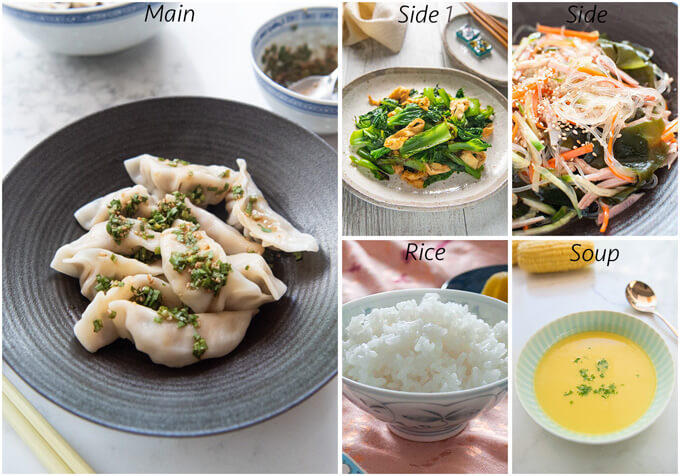
A typical Japanese meal consists of a main dish, a couple of side dishes, a soup and rice. I try to come up with a combination of dishes with a variety of flavours, colours, textures and make-ahead dishes.
Since Sui Gyoza is commonly eaten in China, I decided to pick side dishes that has some association with China. Harusame salad originated in Japan, but it was inspired by Chinese vermicelli dishes. It also adds colours to the meal.
Corn Surinagashi is a Japanese dish, but I thought its bright yellow would be perfect for today’s meal set. You can serve Chinese Corn Soup from Nagi’s recipe if you like.
- Main: Boiled Gyoza Recipe (Sui Gyoza) – today’s recipe, make ahead (freeze them).
- Side dish 1: Chinese Greens Stir-fry – or another stir-fry dish.
- Side dish 2: Japanese Vermicelli Salad (Harusame Salad) – you can make ahead.
- Soup: Japanese-style Sweet Corn Soup (Corn Surinagashi) – or Nagi’s Chinese Corn Soup with Chicken.
- Rice: Cooked Rice.
Absolutely delicious! And super simple!! Thank you – it was so therapeutic to wrap after a long and hectic week at work
Hi Jason, that’s fantastic and thank you for trying! I totally agree with you re wrapping being theraputic.
Interesting boiled gyoza recipe. I love steamed/fried gyoza, I am excited to try it. Please know you make a difference in my life. I enjoy your background information on foods and customs. My heart smiles! You bring back many memories of my stay in Japan. Thank you!
Fond Regards from my smiling heart!
Hi Mari, please do try it and let me know what you think. And thanks for your kind words!
How interesting – have always steamed or fried! Easy also as long as you follow the simple steps – have always loved all of the Asian leaf vegetables . . . so what one has in the fridge 🙂 ! Thanks!
Hi Eha, I know boiled gyoza is not widely known, but it is worth trying.