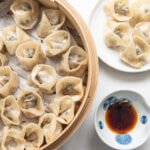
These Steamed Gyoza Dumplings are a variation of the RecipeTin Eats Gyoza recipe. Instead of pan-frying the dumplings, they are steamed. The shape of my gyoza is different, but the filling is very similar to that of pan-fried gyoza.
Steamed Gyoza can be an excellent finger food too.
See the video.
Don't forget to see the section 'MEAL IDEAS' below the recipe card! It gives you a list of dishes that I have already posted and this recipe that can make up a complete meal. I hope it is of help to you.
- 3/5 cup cabbage , very finely chopped (note 1)
- ½ tsp salt , separated
- 3/5 cup garlic chives , finely chopped (note 1)
- 250g / 8.8oz pork mince (ground pork)
- ½ tsp garlic , crushed
- ⅔ tsp ginger , grated
- ⅔ tsp sesame oil
- 1½ tsp soy sauce
- 2 tsp corn flour/cornstarch
- A large pinch corn flour/cornstarch
- 30 round gyoza wrappers (note 2)
- Water in a small bowl
-
Combine half of the salt (i.e. ¼ teaspoon) and the cabbage in a bowl and leave it for 20 minutes to allow the cabbage to wilt.
-
Squeeze out excess water from the cabbage, then place it in a bowl together with the remaining Filling ingredients.
-
Mix the filling well by hand until it becomes almost sticky, ensuring that all the ingredients are evenly combined.
-
Sprinkle a baking tray with a large pinch of corn flour/cornstarch.
-
Place 1 gyoza wrapper on your left palm (for right-handers). Dip your finger in water and run it around the edge of half of the gyoza wrapper (to seal).
-
Place about 2 teaspoons of filling (note 4) in the centre of the wrapper. Fold the wrapper over the filling and seal it to form a semi-circle. When sealing, gently press out the air around the filling so there are no air pockets inside the dumpling.
-
Wet one edge of the wrapper and bring it over to meet the other edge to form a circle. Press the edges together firmly.
-
Repeat with the remaining wrappers.
-
Make a round steaming paper liner with many holes (see the video) that fits inside the steamer. This prevents the gyoza skins from sticking to the bamboo.
-
Place the gyoza on the paper liner without touching each other. You may need to gently push the gyoza down to stand upright.
-
If your bamboo steamer cannot hold all 30 gyoza pieces at once (note 5), steam them in batches.
-
Fill a wok with about 5cm / 2” of water and bring it to a boil.
-
When the water starts boiling, place the bamboo steamer onto the wok and steam for 12 minutes.
-
Please refer to my Shumai Recipe instructions, but steam the gyoza for 12 minutes. You may need more than 1 cup of water to steam for 12 minutes.
-
If you are using a bamboo steamer, you could serve gyoza directly in the steamer. If using a steamer pot/pan, transfer the gyoza to a plate. If steamed on a plate inside a pot, serve the steaming plate with the gyoza on it.
-
Serve with soy sauce, vinegar, and chilli oil, with a small dipping bowls.
1. You can change the ratio of these ingredients as long as the total weight/volume is roughly the same. It doesn’t matter if the weight of the vegetables is slightly more or less than specified.
If you can’t find garlic chives, you can use either normal chives or the green part of the spring onions and double the amount of garlic.
2. You can buy gyoza wrapping sheets at Japanese/Asian grocery stores. Some supermarkets also sell them.
They usually come in packs of 20-30 sheets, but most packs contain 30. The label on the package typically shows either ‘gyoza’ or ‘gow gee’.
3. There are no rules for the ratio of soy sauce to vinegar. Some people may not use vinegar at all.
4. Ideally, each dumpling should contain the same amount of filling. If you want to be precise, weigh the entire filling and divide the weight by 30 to calculate the amount of filling per wrapper.
My filling weighed 380g / 13.4oz, so each dumpling needed 12.7g / 0.45oz of filling, which was roughly 2 teaspoons.
When there are only about 10 wrappers left, I evenly divide the remaining filling among them so that the filling is used up and gyoza pieces are similar sizes.
5. I used a very large bamboo steamer (27cm / 10⅝" in diameter) that could hold 30 gyoza at once. If you have a two-tier steamer, you may also be able to steam them all at once too.
6. You can refrigerate uncooked gyoza in an airtight container the day before you cook them. Uncooked gyoza can also be frozen for a couple of months. You don’t need to defrost them when cooking, but you will need to steam for a couple of minutes longer than cooking fresh gyoza.
Cooked gyoza dumplings can also be stored in the fridge for 2-3 days. To reheat, it is best to steam them for 5+ minutes, but you can also microwave them. Splash water over the dumplings, cover them with cling wrap, and microwave for a few to several minutes depending on the number of dumplings to reheat.
7. Nutrition per piece.
serving: 20g calories: 40kcal fat: 1.2g (2%) saturated fat: 0.3g (2%) trans fat: 0.0g polyunsaturated fat: 0.2g monounsaturated fat: 0.4g cholesterol: 8mg (3%) sodium: 85mg (3%) carbohydrates: 4g (1%) dietary fibre: 0.2g (1%) sugar: 0g protein: 3g vitamin D: 0.1mcg (1%) calcium: 8mg (1%) iron: 0.3mg (2%) potassium: 16mg (1%)