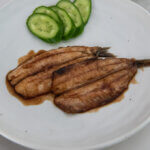
Sardine kabayaki is made in a similar way to eel kabayaki (grilled eel), which is perhaps the best-known kabayaki dish. But Sardine Kabayaki can be just as good as eel kabayaki at a fraction of the cost.
- 4 sardines (about 350g / 0.8lb in total, note 1)
- 2 tbsp flour
- 1 tbsp oil
- 1½ tbsp soy sauce
- 1½ tbsp cooking sake
- 1½ tbsp mirin
- ½ tbsp sugar
-
Mix all the Kabayaki Sauce ingredients well in a bowl or a jar until the sugar dissolves.
-
For each sardine, cut off the head with a knife and trim the flesh along the bottom of the belly, then remove all the guts.
-
Clean the sardines under running water. Run your thumb inside the cavity from the head end to the tail along the backbone, scraping the blood strip with the tip of your thumb.
-
Pat-dry the fish including the inside of the cavity.
-
Hold a sardine horizontally and with your both thumbs push the tips into the centre just above the backbone so that you can feel the bone with your finger pads.
-
Slide your thumbs outward along the bone towards the cut end and the tail end, pushing the thumbs towards the dorsal side.
-
Gently butterfly the fish. The backbone should now be exposed on one side.
-
Break the bone at the point closer to the tail and gently lift the bone up, detaching it from the flesh. The bone will detach easily if you place a few fingers on the tail end of the flesh and press down to hold it while lifting the bone.
-
If the rib bones are still attached, scrape them off by removing the thin layer of the belly part of the flesh.
-
Dust both sides of the sardines with flour.
-
Heat oil in a frying pan at medium high heat.
-
Put the fish pieces in the pan, flesh side down. Cook for 1-1½ minutes.
-
Turn them over and cook a further minute or so.
-
Add the Kabayaki Sauce to the pan and cook for 30-40 seconds (note 3) until the sauce thickens and reduces to about 1-1½ tablespoons. Use a spoon to drizzle the sauce over the fish a few times while reducing the sauce.
-
Remove from the heat (note 4). Transfer the kabayaki to a serving plate, drizzle the sauce over the fish.
1. Each fish was 18-20cm / 7 1/16-8" long from the head to the end of the tail.
Two sardines per serving is a very small portion per person by Western standards. If you wish, you can increase the quantity per serving. In this case, the amount of sauce needs to be increased.
2. See the video. You can also refer to the section ‘HOW TO FILLET SARDINES’ in my post Stuffed Sardines with Perilla and Pickled Prum, which shows a slightly different way of butterflying a sardine. Either method is fine.
3. The time taken to reduce the sauce can vary depending on the heat level and the surface area of your frying pan. Since there isn’t a lot of sauce to begin with, it will not take long to reduce.
4. Do not leave the pan on the hot cooktop, as the residual heat will reduce the sauce too much.